Contemporary Narratives
Not Nigerian Enough, Not Spanish Yet
Celine Aju
Oct 15, 2026 · Contemporary Narratives
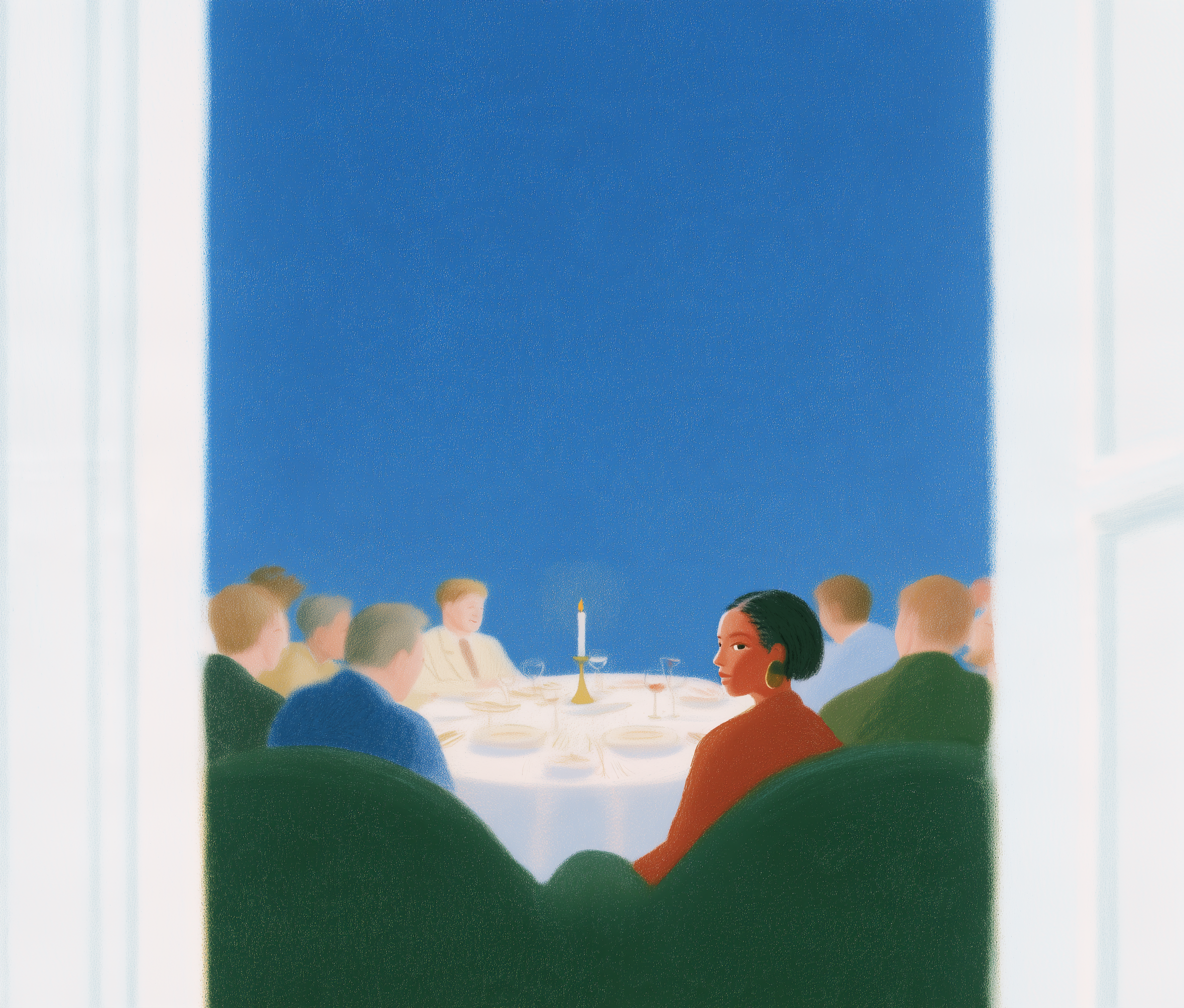
I'm sitting at a restaurant table in Bilbao with colleagues who are all European, and what I am noticing, without bitterness or surprise, is my own otherness. The way you notice the temperature of a room you've just walked into from outside.
It has taken me a while to get to this table. Not the table itself but the country, the city, and the life around it — having worked for years to land here, kicking and scratching for the visa, the role, the rent, and the right to sit where I am sitting tonight.
This is why what I'm now realising catches me off guard. Arriving comes with a finality that is awfully deceptive. It strings you along like the end of a book, when in fact it is only the end of a chapter. One that gives way to another, hard in its own particular way.
It feels like standing at the edge of a cliff after an eight-hour hike. Standing at the summit, asking: do I jump? Do I take the plunge? Do I immerse myself in this thing I've toiled, sweat, and strained for? Standing on the edge of the cliff feels less like an ending, and more like being right in the middle of something. To the left is all I worked hard to build up to this point. To the right is all that is ahead. And for the first time, I notice that in both directions either way, a climb awaits me.
I've been wrestling with this for forty-eight hours now, and the irony of it is not lost on me. In Nigeria I did not live Nigerian enough; I studied French for twelve years, went to certain events and not others, and had already built a self that didn't quite fit in to local cultural expectations. Now, in Spain, I'm realising the same thing in reverse, that I'm not living Spanish enough, that I'm resisting the immersion, that I'm holding on to something I should probably loosen my grip on. And what I am slow to admit, even to myself, is that the things I'm holding on to are not things I can't let go of.
I'm not holding on to the fact that I am Nigerian. That is mine forever. I'm not holding on to my hair, or to the values and instincts I built across two continents and several lifetimes; those things are not in danger and never were. What I'm actually holding on to is smaller and more particular. It has taken days of conversations like this one, noticing each time how I am living as a Nigerian in Spain, to see what it actually is: twelve years of French I don't want to feel wasted, a version of Lagos that no longer exists in Lagos, a set of weekly rituals and friendships and events that have either dissolved or moved on without me, a self that made sense in a place I no longer live.
There is a voice at the back of my mind that keeps asking: you fought so hard to get here, so why won't you let yourself actually be here?
The honest answer is fear. Fear that the visa will be rejected. Fear that I'll have to move again. Fear that if I let myself sink into this place, leaving it one day will undo me. So I hover above it, calling it self preservation.
I'm starting to see, that self preservation is the antithesis of this kind of journey. If I had been built for self-preservation I would not be at this table, in this city, on this continent at all. Self-preservation is the merry-go-round, going round and round and never actually coming to a place of rest. The thing I fought for, kicking and scratching the entire way, requires an undoing of myself in order to be lived.
So I'm letting go of the idea of myself that was in Nigeria, because the environment is different, and now I must explore the version of myself I'm becoming in this place.
Exploring is uncomfortable. It means being slow in Spanish, sitting at tables where my story is the only one of its kind. I don't know what version of me is waiting on the other side. I don't know how long this will take. But I do know that standing still at the edge of a life I prayed for is its own kind of falling.
So I'm going to jump.